4-Month Sleep Regression: What a Sleep Log Can (and Can't) Show
· 4 min read
Around three to five months, many parents notice nights that suddenly feel harder: more wakes, shorter naps, or a baby who used to manage a longer stretch and now does not. People often call that a 4-month sleep regression. Public-health sites rarely use that phrase. What they do describe is a real change in how baby sleep is organised, and night waking that is still common.
This guide explains common guidance from the AAP, NHS and CDC. It isn't medical advice, and it isn't a sleep-training plan. If your baby's sleep worries you, talk to your pediatrician, GP or health visitor.
What is changing around this age
The American Academy of Pediatrics (AAP) says babies do not have regular sleep cycles until about 4 months of age. Newborns may sleep about 16 to 17 hours a day, often in stretches of only 1 or 2 hours. As babies get older they usually need less total sleep, and patterns start to look more like day and night, but every baby is different.
The NHS puts the 3-to-6-month stage this way: your baby will need fewer night feeds and may be able to sleep for longer. Some babies may sleep for 5 to 8 hours or longer at night; not all will. On its sleep-patterns page it also notes that some may sleep for 8 hours or longer at night, but again not every baby.
So the popular word "regression" can be misleading. Sleep is often becoming more organised, not going backwards. What parents feel is the rough patch while that organisation shows up: more awareness at the end of a sleep cycle, more night waking, naps that do not line up the way last month's did. A single rough night is not a pattern. Several nights in a row, next to shorter daytime sleeps, is what people usually mean.
Safe sleep still comes first
Tired nights are when shortcuts feel tempting. The AAP and CDC both support the same core safe-sleep steps for every sleep, naps and night:
- Put your baby down on their back.
- Use a firm, flat sleep surface (crib, bassinet or play yard that meets safety standards), with a fitted sheet.
- Keep the sleep space empty: no pillows, blankets, bumpers, soft toys or loose bedding.
- Room-share on a separate surface. The NHS advises the same room for at least the first 6 months, day and night; the AAP recommends sharing a room for at least the first 6 months.
The CDC notes that newborns wake every few hours to feed, day or night, and that sleepless nights are temporary for many families. None of that changes the safe-sleep rules above. BabyTrack+ is a log only. It does not monitor breathing or replace a safe sleep space.
What is worth logging for a week
You do not need a perfect spreadsheet. For five to seven days, these entries are usually enough to see a pattern and to answer questions at a checkup:
- When each nap started and roughly how long it lasted.
- Bedtime (when you put them down) and morning wake.
- Night wakes you had to respond to, with a rough time.
- Overnight feeds, next to those wakes.
Keep notes short. "Nap 13:10, 35 min" and "woke 02:40, fed, back down 03:05" beat trying to record every stir. Missed nights happen; write what you remember and move on.
How to read the log without overthinking it
Look at the whole week, not one bad stretch:
- Repeated wake times. The same clock hour three nights running is more informative than one 3 a.m. wake.
- 24-hour totals. One endless night feels like no sleep at all. Seeing total sleep for the day next to yesterday puts it in proportion.
- Nap length trends. Several very short naps across a few days, or one long afternoon nap that pushes bedtime later, show up more clearly on paper than in memory.
- Feeds next to wakes. Hunger and sleep tangle. Seeing both in one timeline helps you describe the night to a professional without guessing.
A log cannot tell you why a baby woke, diagnose a regression, or prove that a method is working. It only shows what happened.
How BabyTrack+ fits
In BabyTrack+, a sleep entry is a duration. Log it from the phone or the Apple Watch, or ask Siri on iPhone. On iPhone you can also start a sleep so a timer runs on the Lock Screen and in the Dynamic Island, then tap Woke up to end it, on your phone or a co-parent's.
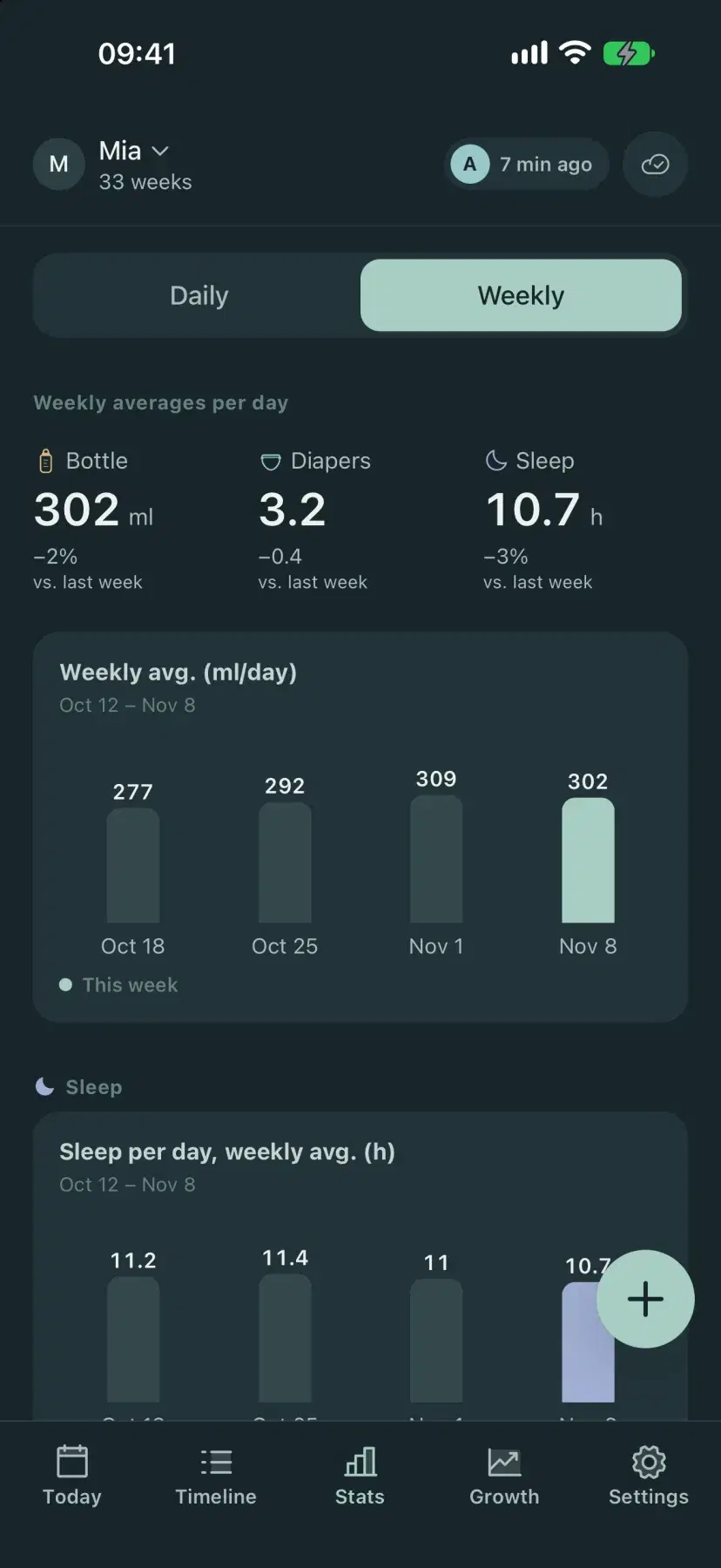
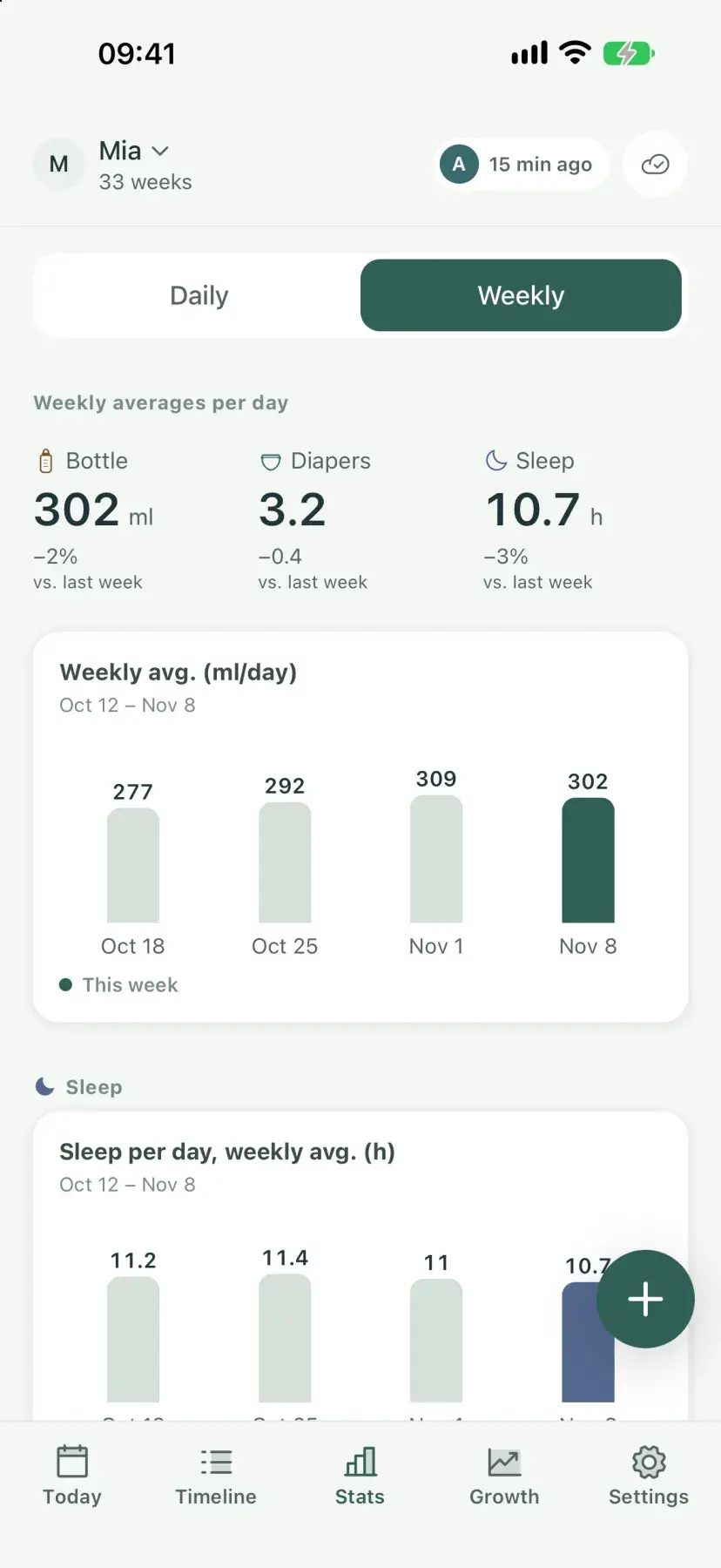
The stats screen shows today's total sleep next to yesterday's, and the week view shows daily averages over the last four weeks, alongside feeds and diapers. The timeline keeps every nap and night stretch in order.
For how much newborns usually sleep before this stage, see How much do newborns sleep?. Feeds often sit next to night wakes, so How often should a newborn feed? helps for the early weeks. When two people share nights, see How to share a baby log with your partner.
Sources
Keep the log in one place
BabyTrack+ records feeds, diapers, sleep, solids, and growth on your phone, offline. Free for one baby.