Baby-Led Weaning First Foods: A Checklist by Stage (Based on NHS Guidance)
· 5 min read
This guide follows NHS guidance on starting solid foods. It sets the foods out by stage, so you can use it as a list to track what your baby has tried.
Before you start: is your baby ready?
The NHS recommends starting solid foods at around 6 months. It lists three signs that appear together. Your baby can:
- stay in a sitting position and hold their head steady
- coordinate eyes, hands and mouth to look at food, pick it up and put it in their mouth
- swallow food rather than spit it back out
Chewing fists or waking more at night are not, on their own, signs of readiness.
The NHS also notes that babies who start around 6 months may move on to mashed, lumpy and finger foods more quickly, and may not need smooth, blended foods at all. That's the idea behind baby-led weaning.
Gagging and choking
Seat your baby upright in a high chair with the harness fastened, so they can swallow properly. Stay with them while they eat, and never leave a baby unattended on a raised surface.
Gagging is common when babies start solids. They may retch, push their tongue forward or have watering eyes while they learn to manage food. Choking is different: the cough is silent or the baby can't breathe in properly. The NHS page on how to stop a child from choking explains what to do.
Some foods need preparing:
- Cut small, round foods such as grapes, cherries, berries and cherry tomatoes into quarters.
- Give nuts only crushed or ground. Whole nuts are a choking risk for children under 5.
- Raw jelly cubes can be a choking hazard for babies and young children.
Stage 1: around 6 months
Getting used to eating matters more than how much. Milk is still where most of the energy comes from.
Vegetables, soft-cooked, as finger foods or mashed. Offer some with less sweet flavours:
- broccoli
- carrot
- cauliflower
- courgette
- parsnip
- sweet potato or butternut squash
- avocado
Fruit, soft and ripe or cooked if harder, with pips, stones and hard skin removed:
- banana
- pear
- apple (cooked)
- mango
- blueberries (squashed)
Starchy foods and dairy:
- toast fingers
- pasta
- full-fat plain yoghurt, no added sugar
- pasteurised full-fat cheese
Protein foods carry iron and zinc, which babies need. The NHS lists beans, lentils, chicken and fish:
- lentils or mashed beans
- chicken
- fish, with the bones removed
Cool cooked food right down before you offer it.
Allergenic foods
From around 6 months, the NHS advises offering foods that can cause allergic reactions one at a time and in small amounts, so you can spot a reaction. The list it gives:
- cows' milk (in cooking or mixed with food)
- eggs
- foods that contain gluten, such as wheat, barley and rye
- nuts and peanuts
- seeds
- soya
- fish
- shellfish
Egg needs care. Eggs stamped with the red lion mark can be served lightly cooked or runny. Cook any other egg until the white and yolk are solid.
Nuts, peanuts and seeds go in crushed or ground, mixed into food. Nut butter can be spread on toast or stirred into porridge or a curry. Don't give it on its own, and don't give whole nuts. Shellfish must be cooked through, never raw or lightly cooked.
If your baby has eczema or a food allergy, or allergies run in your family, talk to your GP, health visitor or pediatrician before you start. How to introduce these foods, and how to keep them going, is in Introducing allergens to your baby.
Stage 2: 7 to 9 months
Your baby gradually moves towards 3 meals a day (breakfast, lunch and tea). Keep offering mashed, lumpy and finger foods, and a wide variety, including foods rich in iron.
- a widening range of vegetables and fruit
- protein foods such as beans, lentils, fish, eggs and meat (see the NHS 7 to 9 months page)
- foods your baby refused. The NHS says it may take 10 tries or more
Babies under 12 months don't need snacks. If your baby seems hungry between meals, offer an extra milk feed.
Stage 3: 10 to 12 months
Your baby should now be used to 3 meals a day, plus milk feeds, and should manage mashed, lumpy, chopped and finger foods. Lunch and tea can have a main and a pudding, such as fruit or unsweetened yoghurt. Eat together when you can, because babies learn by watching you.
Foods to avoid
The NHS advises against these for babies:
- Salt. Don't add it to food or cooking water, and skip stock cubes, gravy, bacon, sausages, crisps and ready meals.
- Sugar and sweeteners, for children aged 4 or under. That includes honey, syrup, fruit juice and smoothies. Fruit itself is fine.
- Honey, until your child is over 1 year old, because of the risk of infant botulism.
- Whole nuts, until age 5.
- Raw or lightly cooked shellfish, such as mussels, clams and oysters, which raise the risk of food poisoning.
- Mould-ripened soft cheeses such as brie and camembert, ripened goats' milk cheese, soft blue cheeses such as roquefort, and any unpasteurised cheese.
- Shark, swordfish and marlin, for everyone under 16, because of the mercury in them.
- Rice drinks as a replacement for breast milk or formula, for children under 5.
- Cows' milk as a main drink, until 1 year. It is fine in cooking.
Keeping track
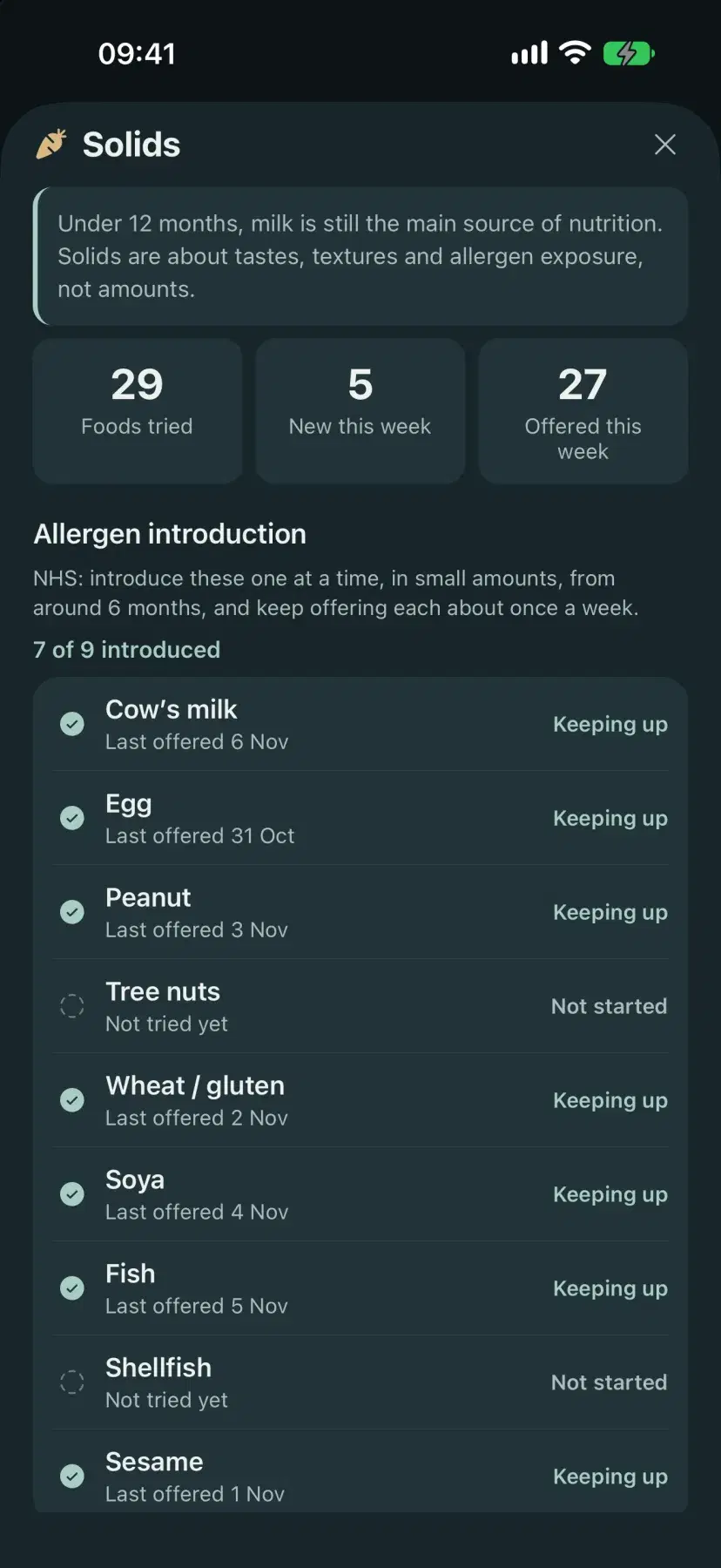
The checklist works on paper. If you'd rather keep it on your phone, the solids tracker in BabyTrack+ lets you log each meal food by food, from a list of 110 first foods or your own, along with how much was eaten. It follows nine common allergens, warns you if one meal contains two new ones, and flags an allergen you haven't offered for about a week.
When to get help
Mild symptoms, such as a few hives around the mouth, are a reason to stop that food and speak to your GP or health visitor.
Call 999 (or your local emergency number) straight away if your baby has swelling of the lips, mouth or tongue, struggles to breathe or breathes very fast, turns pale or blue, becomes floppy or unresponsive, or suddenly seems very drowsy. These can be signs of anaphylaxis.
If your baby is choking and can't cough or breathe in, shout for help and follow the NHS choking first aid. Call 999 if the blockage doesn't come out or your baby becomes unconscious.
Sources
Keep the log in one place
BabyTrack+ records feeds, diapers, sleep, solids, and growth on your phone, offline. Free for one baby.