Baby Head Circumference Percentile: What It Means and How to Check It
· 3 min read
Your baby's head is measured, the number goes on a chart, and someone mentions a percentile. This guide explains what that percentile compares, how head size is measured, and when clinicians look more closely.
What the percentile means
A head circumference percentile compares your baby's head with other babies of the same age and sex. If it's on the 40th percentile, about 40 in 100 babies that age have a smaller head and about 60 have a larger one.
It's a position, not a score. Heads come in different sizes, and one that sits on the 20th percentile is not a worse head than one on the 80th.
Very small and very large measurements are the exception, and they are the reason head size is tracked at all. For the WHO charts, the CDC recommends the 2.3rd and 97.7th percentiles to flag possible abnormal growth. Cleveland Clinic describes microcephaly as a head circumference at or below the 3rd percentile. Your health visitor or pediatrician decides what a measurement means for your baby and what comes next.
Where the numbers come from
BabyTrack+ uses the WHO Child Growth Standards (2006), based on healthy breastfed children in six countries. The study is described in How to read WHO growth charts.
The WHO publishes head circumference-for-age from birth to 5 years. BabyTrack+ and our calculator use the birth-to-24-months range. For each age and sex, the WHO gives three values (L, M and S) that describe the curve. A measurement becomes a z-score, and the z-score becomes a percentile.
How head circumference is measured
Clinics use a flexible tape that doesn't stretch, according to the University of Washington's growth measurement module. The tape goes just above the eyebrows and ears and over the most prominent part at the back of the head, snug enough to press the hair flat. The CDC's anthropometry manual has the tape slid up and down at the back to find the largest circumference.
A wriggly baby or a slightly different tape position changes the number by a few millimetres, so one reading tells you less than several. When a head looks unusually small or large, NICE guidance for clinicians is to take three measurements at the same appointment and plot the largest.
If you measure at home, repeat it a few times and treat the result as a rough figure. The clinic's measurement is the one to rely on.
When head size is measured
Head size is typically measured at birth and at some routine checks, and which ones depends on where you live. In the UK, the NHS lists it as part of the 6 to 8 week check, and routine weighing visits don't always include it. Your baby's health record (the red book in the UK) or your health visitor will tell you which checks include it.
The line matters more than the dot
Clinicians compare each measurement with earlier ones. A head that has tracked near one percentile is following its own curve.
For weight and height, the NHS says it's normal for measurements to move up or down by one centile line. As How to read WHO growth charts explains, crossing two or more lines is a reason to ask your health visitor or pediatrician, and it doesn't automatically mean something is wrong.
Check a measurement
Our free WHO percentile calculator takes your baby's sex, date of birth and head circumference in cm or inches, and shows the percentile. It works up to 24 months. Everything is calculated in your browser, and nothing you enter is sent or stored.
Keeping a record
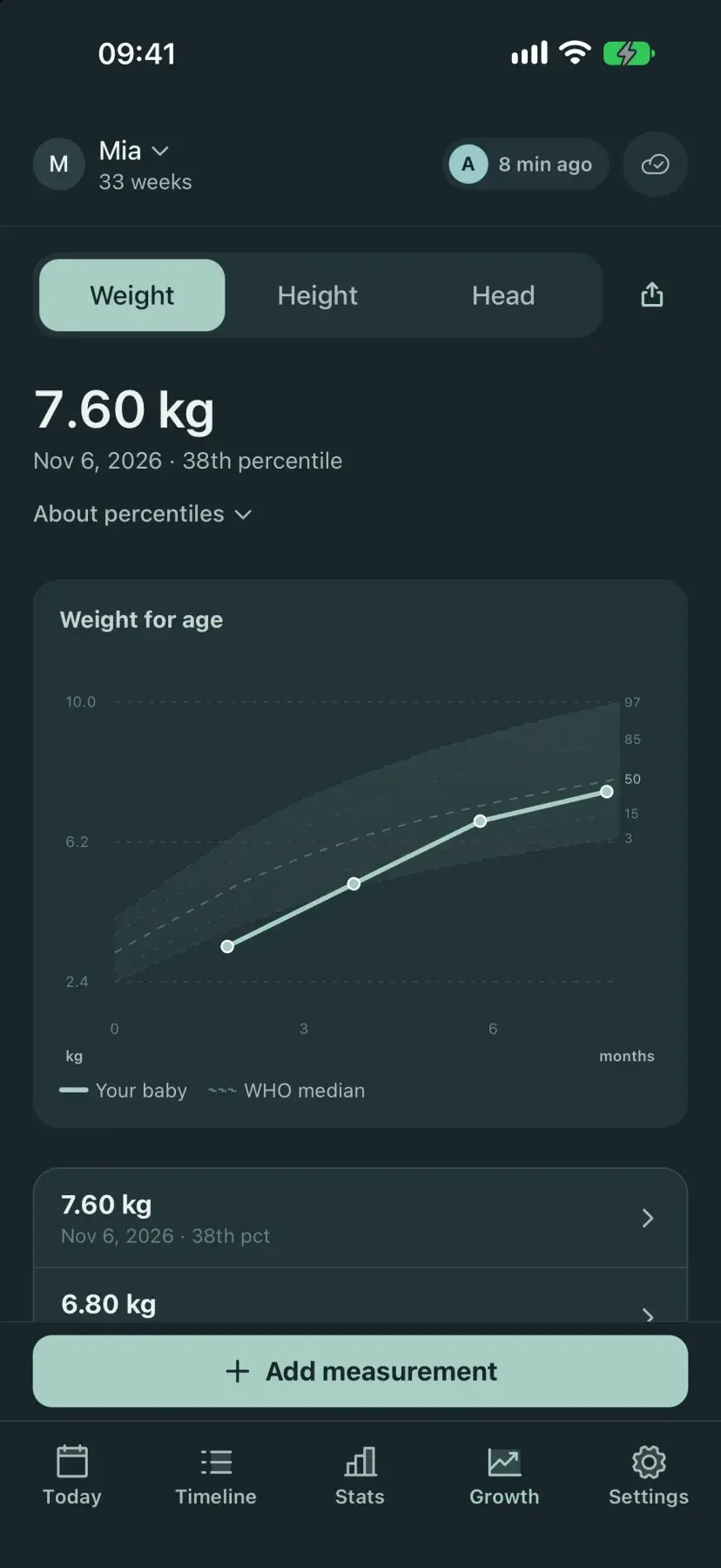
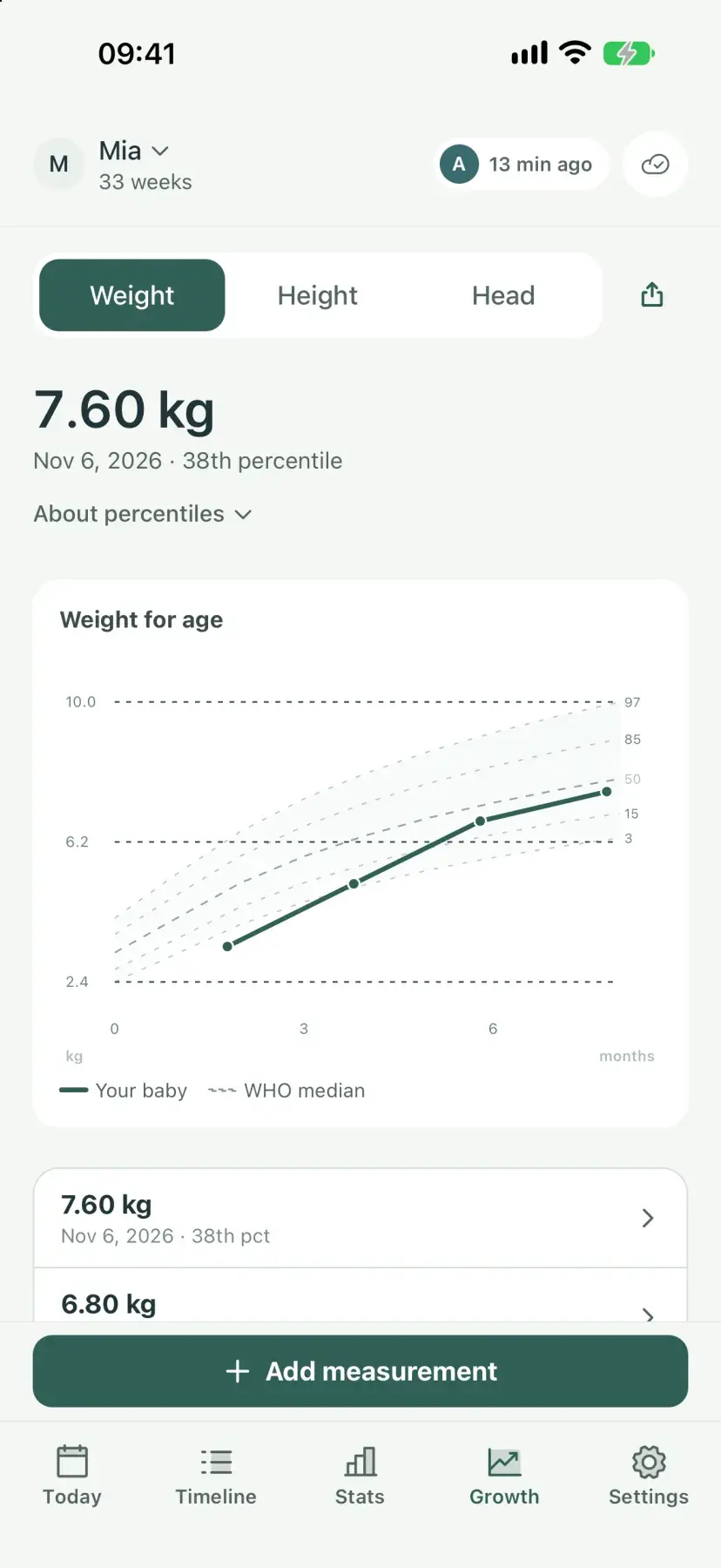
Checkups are weeks apart. In BabyTrack+, the growth tab keeps weight, length and head circumference together, plotted on WHO percentile curves for boys or girls. It works offline, with no account. When you see your health visitor, you have every measurement and date to hand.
When to ask a professional
Ask your health visitor, GP or pediatrician if something about your baby's head size, shape or growth worries you, or if you were told to come back for another measurement.
Sources
- WHO: Child growth standards
- WHO: Head circumference-for-age
- NHS: Your baby's health and development reviews
- NHS: Your baby's weight and height
- NICE quality statement 2: Head size and shape in children
- CDC: Use of WHO and CDC growth charts for children aged 0 to 59 months (MMWR)
- Cleveland Clinic: Microcephaly
- CDC NHANES Anthropometry Procedures Manual: head circumference
- University of Washington: Growth measurement training module
Keep the log in one place
BabyTrack+ records feeds, diapers, sleep, solids, and growth on your phone, offline. Free for one baby.